

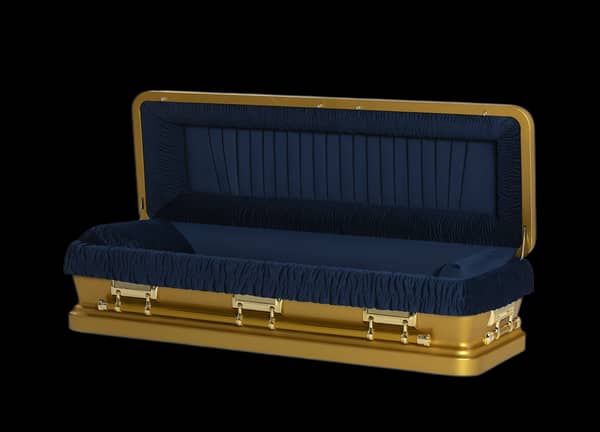
What Is An Open Casket Funeral?
An open casket funeral is a funeral in which the casket is open, revealing either part or all of the deceased’s
body. Many caskets are designed so that half of the lid can be open to reveal the body’s head and torso; these
caskets are referred to as “half-couch” caskets, hwhile full-couch caskets have lids that open entirely.
Typically, the casket is located at the front of the room in which the funeral service is being held (whether in a
place of worship or at a funeral home), although sometimes the casket is located in a side room.
An open casket funeral is a service where the casket ish opened so mourners can see the body of the person
who has died, usually the face and upper body, during the visitation or funeral itself.meri+2
The body is typically embalmed, dressed, and given hair and makeup so it looks peaceful and presentable, and
people can approach the casket to say a final goodbye before it is closed for burial or cremation.titancasket+3
There is no precise national statistic published for “what percentage of U.S. funerals are open casket,” but
available information suggests they are common among funerals where a body (not just ashes) is present.titancasket+1
What percentage of US funerals are open casket
- U.S. funeral sources describe open‑casket funerals or visitations as “relatively common” and “the norm”
- in many traditions, especially Catholic and Protestant, while noting that practice varies by region and faith.hindmanfuneralhomes+1
-
Because cremation now accounts for about 60%+ of dispositions in the U.S., only the smaller share that
- still choose body burial (roughly one‑third of deaths) even have the option of an open casket; within that
- group, embalmers and directors often report that most services with a body present include at least some period of open casket viewing.volumeone+2
So, while a specific percentage is not documented, a reasonable summary is: among traditional U.S. funerals
with a body present, open casket viewings are more common than not, but if you include all deaths (especially cremation‑only memorials), open‑casket funerals are a minority overall.
Open casket funerals in Europe vs America
Open casket funerals are much more common and culturally expected in the United States than in most European countries.titancasket+1
United States
- In the U.S., open casket visitations or viewings are relatively common, especially with Catholic and many
- Protestant Christian traditions, often with a viewing while the casket is open followed by a closed‑casket funeral service.facebook+2
-
Embalming is widely used, which keeps the body looking more presentable for days, and many families see viewing the body as important for closure.reddit+2
Europe
-
In much of Europe (for example, the UK), closed‑casket funerals are more typical; bodies are usually not
-
on open display, and services focus on the coffin as a symbolic container rather than a window to the body.boards.straightdope
-
Embalming is less common and there is greater emphasis on privacy and modesty, so viewings are
-
shorter, rarer, or limited to family, if offered at all.holmesfunerals+1
In short: open casket viewing is a familiar, often expected option in many U.S. funerals, whereas in much of
Europe it is unusual and the norm is a closed casket with the body not on public display
Psychological effects of viewing the body at open casket
Viewing the body at an open‑casket funeral can have both helpful and painful psychological effects, and the
impact depends on the person, their relationship to the deceased, and the circumstances of death.pmc.ncbi.nlm.nih+2
Potentially helpful effects
-
Reality and acceptance: Seeing the body can drive home that the person has really died, helping to
-
reduce denial and making the loss feel more “real,” which can support healthier long‑term grief.selectedfuneralhomes+2
-
Closure and saying goodbye: Many mourners report feeling that they can properly say farewell,
-
which can ease guilt, regret, or “unfinished business” and leave a gentler final image of the person.casketemporium+2
-
Social and ritual support: Being with others who also see the body can create a shared emotional
-
experience, reinforcing community and providing comfort that “you’re not alone” in your grief.prairierosefunerals+1
Potentially difficult or risky effects
-
Short‑term distress: Some people feel shocked, overwhelmed, or horrified, especially after a traumatic or sudden death, and may have intrusive images or nightmares afterward.everplans+2
-
Varies by trauma and age: Views after violent or disfiguring deaths tend to produce more immediate distress, though research on traumatic deaths suggests that those who do view are not clearly worse off long‑term and may sometimes be less distressed later.reddit+1
-
Individual differences: Some people find viewing comforting, while others feel it is unnecessary or even harmful; for many, it is a personal choice, and they can still grieve well without seeing the body.rememberingalife+2