

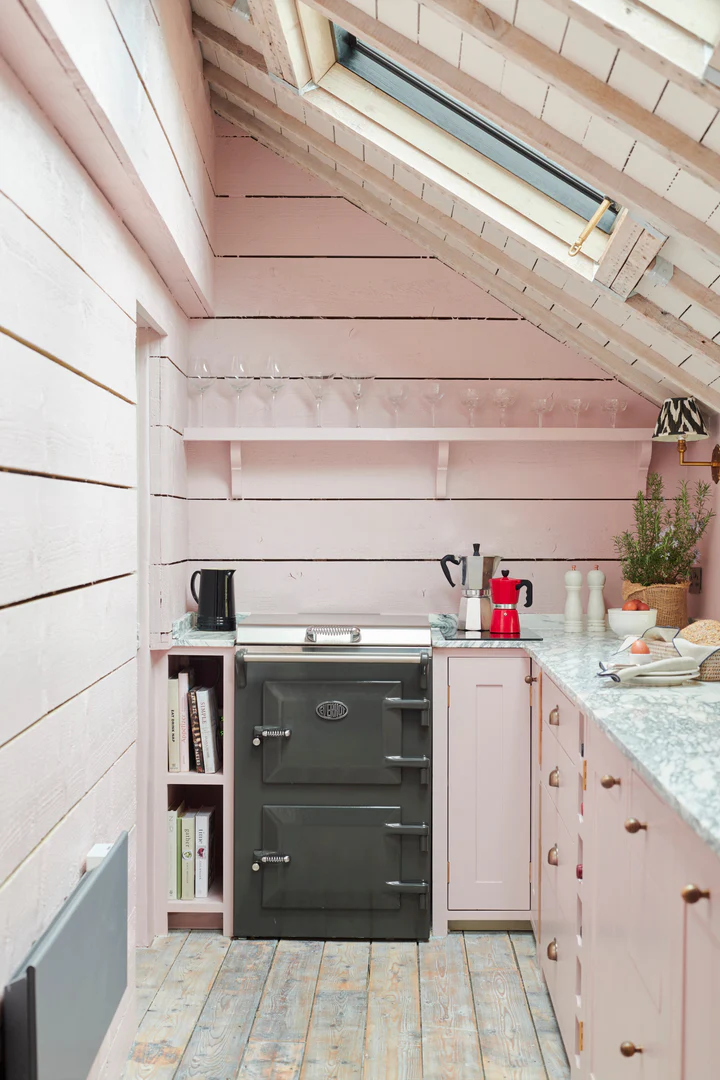
Gallery Kitchen Ideas: Designing A Narrow Kitchen
Galley kitchens have a reputation for being tricky to get right, but in truth, they are among the most efficient and rewarding kitchen
layouts to design. Named after the compact cooking quarters found on ships, a galley kitchen features two parallel runs of cabinetry with a
walkway between them, and it is a layout that has stood the test of time for good reason. Everything you need is within arm’s reach, there
is no wasted space, and with the right design decisions, even the narrowest of rooms can feel considered, characterful and entirely your own.
Whether you are starting from scratch or rethinking an existing galley kitchen layout, the key lies in thoughtful planning – from how you
arrange storage and appliances to the colours and finishes that will shape the feel of the room. ‘A kitchen is a jigsaw puzzle,’ says
”Enduring Crafts”, one of our kitchen design specialists. ‘Decide on appliance placement first, then plan storage around it.’
We share our galley kitchen ideas to help you make the most of a long, narrow space – covering layout, storage, colour, and the small but
meaningful design details that can make all the difference.
What is a galley kitchen?
A galley kitchen layout is defined by its long, narrow footprint, with cabinetry and worktops arranged along two facing walls and a central
walkway running between them. It is a layout that prioritises efficiency above all else, and it is no coincidence that professional restaurant
kitchens follow a very similar principle, with stations arranged in parallel rows so that everything a chef needs is close to hand.
There are two main variations to consider. A single galley kitchen places cabinetry along one wall only, leaving the opposite side open – a
good option for particularly narrow rooms or spaces that double as a throughway. A double galley kitchen, the more traditional
arrangement, makes use of both walls and offers significantly more storage and worktop space. The right choice will depend on the dimensions of your room and how you use it day to day.
Galley kitchens are especially common in British homes, and for good reason. The long, narrow footprints of Victorian and Edwardian
terraced houses, period cottages with their low beams and awkward nooks, andhcompact city flats all lend themselves naturally to this
layout. Rather than fighting the proportions of these spaces, a well-designed galley kitchen works with them – turning what might feel like a limitation into a room that is focused, functional and full of character.
In a galley kitchen, storage is everything. With limited floor space, the goal is to make every cupboard, drawer and shelf work as hard as
possible, and that starts with thinking carefully about what you need to store and where it should live.‘Decide on appliance placement first,
then plan storage around it – spice racks and utensils near the hob, for instance,’ advises Chloë, one of our kitchen design specialists.
‘Every kitchen needs at least one deep pan drawer. You can get so much more in them than cupboards, and you don’t need to get down on
your knees to reach the back. Maximise space with dividers inside.’
Deep drawers are particularly well-suited to galley kitchens, where reaching into the back of a low cupboard can feel awkward in a narrow
space. Look for drawers that conceal smaller drawers within – useful for keeping organised alongside crockery in a single unit – and
consider for spice jars, knife dividers and narrow niches for and These are small details, but in a compact kitchen, they make a noticeable
difference to how the room functions day to day.
For wall and larder storage, it is worth thinking vertically. ‘Using the walls efficiently and effectively and adding a ladder rail to reach high
cabinetry can look very dramatic,’ explains Jackie, kitchen designer at our Edgbaston store. If ceiling height is restricted, open shelves can
work in place of wall cabinetry – they keep the room feeling lighter while still offering easy access to the things you reach for most often.
Meanwhile, features like zig-zag shelf fittings allow you to position shelves at precisely calibrated levels so that none of the cupboard’s
height goes to waste, and shelf risers raise items towards the back of a cupboard, making everything visible and easier to reach.
A larder cupboard can be transformative in a galley kitchen, even where space is tight. A half-depth pantry cupboard, for instance, still
leaves worktop space in front while providing floor-to-ceiling storage behind, an excellent way to house a pantry in a smaller room. Doors
that swing open with shallow shelves on the back and racks inside add further capacity without taking up additional wall space.
Then there are the details that quietly elevate the everyday: hanging racks and pegs fitted underneath cupboards or on their sides, the that
sits inside your sink cabinet to stop damp cloths cluttering the worktop, and that fit inside other storage to keep smaller items in order.
‘Sometimes the simplest ideas are the most effective,’ says ”Enduring Crafts”.
One homeowner who put many of these principles into practice is Nigel, who designed a galley kitchen, using our for his Cotswolds
cottage. His long, nine-hundred millimetre drawers proved, in his words, ‘a god-send: they fit all the pans and crockery and work incredibly hard.’ An integrated bin helped to streamline the L-shaped layout, while an unused, low doorway to the garden was ingeniously
repurposed as a coffee station – with a shallow wall cabinet at floor level and underlit shelves fitted into the nook created by the
doorframe. It is a reminder that the best galley kitchen ideas often come from working with the quirks of a space rather than against them.
Colour has a significant influence on how a galley kitchen feels, and there is a common assumption that narrow spaces demand pale, neutral schemes to keep things light and airy. That can certainly work well – but it is far from the only option.
‘Using a darker tone all over can make a room really cocooning,’ says Jackie.
The key with small galley kitchen designs is that colour should work for the room and how it is used, not against it. A considered palette, whether bold or restrained, will always feel more intentional than simply defaulting to white.
Ina galley kitchen, where natural light can be limited by the depth and proportions of the room, a well-considered lighting scheme makes a real difference, both to how the space feels and how comfortably you can work in it.
Start with natural light. If your galley kitchen has a window, try not to crowd it with wall cabinetry. Open shelving on either side of a window, or keeping that wall free of upper units altogether, allows daylight to travel further into the room. In period properties where windows tend to be smaller, this alone can shift the atmosphere of the space considerably.
And accent lighting – a a dining nook, or underlit shelves like those in Nigel’s Cotswolds galley kitchen – adds character and draws the eye to particular features.
The combination of all three is one of the simplest galley kitchen ideas to get right, and it makes the difference between a space that feels flat and one that feels warm, inviting and layered
Much of what makes a galley kitchen feel spacious has less to do with actual square footage and more to do with how the eye moves through the room. A few considered design choices can change the sense of space entirely.
Mixing open and closed storage is one of the most effective approaches. Glass-fronted wall cabinets or sections of open break up long,
uninterrupted runs of cabinetry and stop the room from feeling boxed in. Fred reinforces this point: ‘Too many heavy cabinets or too
much busyness above the worktop can make a room feel oppressive, so mix in open shelving with glass-fronted wall cabinets, and embrace
plain wall space as a spot to display art.’
At floor level, pedestal legs rather than solid plinths give cabinetry the appearance of lighter, less fitted, and better suited to the
proportions of a narrow room. It was a deliberate choice in Nigel’s Cotswolds galley kitchen: ‘They make the cabinets look like pieces of
furniture rather than a sleek fitted kitchen, which works in a property of this age.’ Both sides of a galley kitchen need not mirror one
another exactly, either. Grouping taller cabinetry on one wall and keeping the opposite side lower and more open avoids a corridor-like
feel and introduces a natural sense of rhythm to the room.
Underfoot, consider the direction of your flooring. Boards or tiles laid lengthways along the room will naturally draw the eye toward the
far wall and make the space feel longer, while a herringbone or diagonal pattern can add visual width. Keeping worktops as clear as
possible also contributes – a dedicated breakfast larder to house the kettle, toaster and coffee machine, or an integrated chopping block
below the counter, removes clutter without sacrificing convenience.
‘Don’t butt cabinetry right up to a chimney breast; give it room to breathe. It will have a big impact on the room’s sense of space.’ Working
Nigel is something of a Neptune kitchen aficionado, having installed four other Neptune kitchens in previous homes. For his latest project
– a bijoux Cotswolds cottage shared with his partner, David – the brief was a galley kitchen with character. ‘While this is a beamed country
cottage, I didn’t want it to feel predictably chintzy,’ Nigel explains.
together. shallow Suffolk wall cabinet at floor level and underlit shelves fitted into the nook created by the doorframe.
When it came to decoration, Nigel chose finishes that would work with the heavily veined Arabescato marble work surface. The floor was a
sits comfortably against the beams and stonework of the cottage.
It is one of those galley kitchen designs that proves a narrow layout need not feel like a compromise. With thoughtful planning and a
Filed in: hKitchen